

Research
Exploration of ultrafast time-scale stochastic phenomena (fluctuations)
We have been the first in the world to propose and demonstrate a technique for experimentally observing the stochastic motion of “fluctuating” spins (spin noise) on the picosecond time scale.
Selected Publications:
- Nature Communications 14, 7651 (2023):At the University of Konstanz, we succeeded in measuring the steady-state thermal fluctuation dynamics of spins excited by room-temperature thermal energy as an autocorrelation function, by statistically analyzing the polarization noise sensed by femtosecond probe pulses interacting with a magnetic material. We believe this was one of the earliest studies to observe stochastic phenomena on ultrafast time scales in elementary excitations of solids.
- Review of Scientific Instruments 95, 083005 (2024):This is a technical paper that provides a detailed explanation of the experimental setup used in the above Nature Communications paper (femtosecond noise correlation spectroscopy), including the mathematical formulations. It is a collaborative work with the University of Konstanz.
- arXiv:2501.17531. :This is a technical paper in which we developed a methodology to quantitatively evaluate the signals of femtosecond noise correlation spectroscopy. It is currently under review at Physical Review Applied.
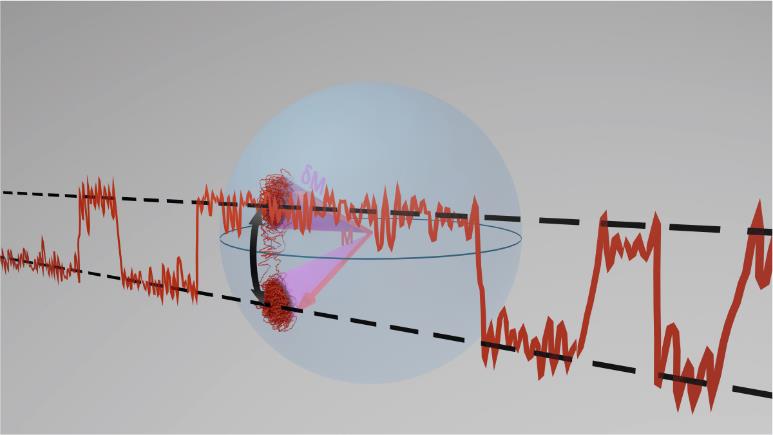
Schematic of picosecond-scale random up–down magnetization switching in the weak ferromagnet orthoferrite.
Nature Communications 14, 7651 (2023)
Development of ultrashort-pulse laser sources
We have developed femtosecond laser sources with phase stabilization and pulse durations of only a few optical cycles, designed for nonlinear optics experiments.
Selected Publications:
- Optica 5, Issue 11, pp. 1474-1477 (2018):We demonstrated that by circularly focusing THz waves generated during the ablation of a metal film with a petawatt laser, it is possible to produce Z-polarized THz radiation with a strong electric field along the propagation direction. This work was conducted in collaboration with the University of Jena.
- Optics Letters 47, 3552-3555 (2022).:Using erbium fiber technology, we generated ultrashort femtosecond pulses compressed down to ~4 fs in the near-infrared range (0.9–2.2 μm) and observed quantum interference currents in GaAs. This research was conducted at the University of Konstanz.
- Opt. Express, 31(7), 11649–11658 (2023).:At the Institute for Solid State Physics, University of Tokyo, we constructed a degenerate OPA based on a 100-kHz Yb:KGW regenerative amplifier laser, generating broadband mid-infrared radiation at 1.7–2.4 μm and achieving femtosecond pulses compressed to about two optical cycles.
- Applied Physics Express 17, 122006 (2024).:At the Institute for Solid State Physics, University of Tokyo, we constructed an OPA driven by a 10-mJ-class Ti:sapphire chirped-pulse amplification system, generating high-intensity mid-infrared radiation in the 3-µm band with pulse energies of several hundred microjoules. Using this source, we discovered that high-order harmonic generation from water films is enhanced by prepulse irradiation.
- Applied Physics Express, 2025:At the Institute for Solid State Physics, University of Tokyo, we constructed a noncollinear OPA using LiB₃O₅ (LBO) as the amplification crystal, enabling the amplification of visible light while suppressing crystal damage caused by two-photon absorption under 343 nm (third-harmonic of Yb:KGW regenerative amplifier) pumping. This setup generated visible femtosecond pulses with a pulse width of 11 fs.
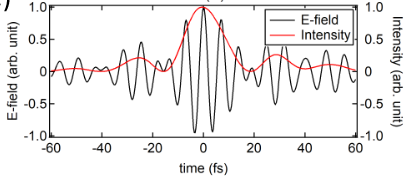
Waveform of a two-cycle ultrashort laser pulse in the 2-μm mid-infrared region.
Opt. Express, 31(7), 11649–11658 (2023)
Control of antiferromagnetic spin systems using terahertz waves
Using high-intensity terahertz waves and plasmonics techniques, we have investigated the nonlinear dynamics of strongly driven spin systems, primarily in antiferromagnetic orthoferrites.
Selected Publications:
- Phys. Rev. Lett. 120, 107202 (2018):At the Institute for Solid State Physics, University of Tokyo, we demonstrated that high-intensity THz waves can dynamically break the symmetry of magnetic phase transitions and generate macroscopic magnetization. This became one of the earliest studies to achieve macroscopic magnetization control using intense THz radiation.
- Commun Phys 6, 51, 1–6 (2023):At the Institute for Solid State Physics, University of Tokyo, we demonstrated that intense THz waves can excite the second harmonic of magnons, which can be observed through the magneto-birefringence effect.
- Nature Physics (2024). https://doi.org/10.1038/s41567-024-02386-3:In collaboration with MIT, we observed nonlinear coupling between different magnon modes using two-dimensional THz spectroscopy.
- Nature Materials 1 (2024), https://doi.org/10.1038/s41563-024-02034-4:In collaboration with Kyoto University, we successfully achieved instantaneous reversal of magnetization in a magnetic material using an ultra-intense THz magnetic field.
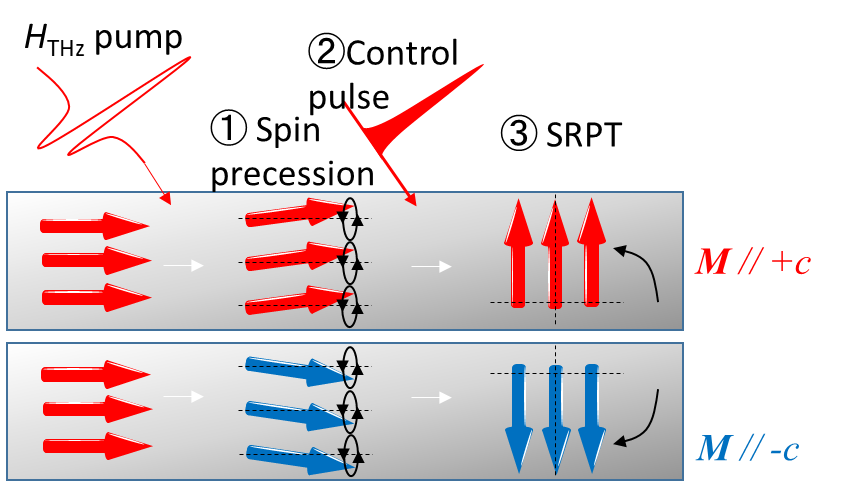
Symmetry-controlled spin reorientation and macroscopic magnetization using intense THz fields and optical triggers
Phys. Rev. Lett. 120, 107202 (2018)
